

AI SPERA’s Criminal IP, a cyber threat intelligence platform that provides actionable intelligence and attack surface visibility to security teams worldwide, will attend GovWare 2026 in Singapore.
As security operations increasingly focus beyond asset discovery to understanding, prioritizing and responding to threats, Criminal IP introduces AITEM (AI-Powered Threat Exposure Management), its vision for the next evolution of attack surface management.
From Visibility to Action: Why ASM Must Evolve
Traditional ASM tools have served a critical purpose: helping companies discover Internet-facing resources such as servers, domains, IP addresses, and admin panels before attackers do. But discovery alone is no longer enough.
“Detecting a threat and responding to it are completely different challenges,” said Byungtak Kang, CEO of AI SPERA. “Building a safer cyber world requires a shift from visibility to action.”
Companies now have more visibility than ever before, but many still struggle to effectively prioritize and respond to the risks it uncovers. By using AI to filter out disruptions, enrich context, and drive investigations, security teams can focus on the threats that matter most and respond in real time to turn insights into meaningful actions.”
The gap between detection and action has become even more critical as AI lowers the barrier for attackers. Through automated scanning, published proof-of-concept exploit code, and AI-powered vulnerability detection, threat actors can identify and attack exposed assets faster than ever before. The defender’s challenge is no longer just visibility, but speed of reaction.
AITEM: The next evolutionary stage of attack surface management
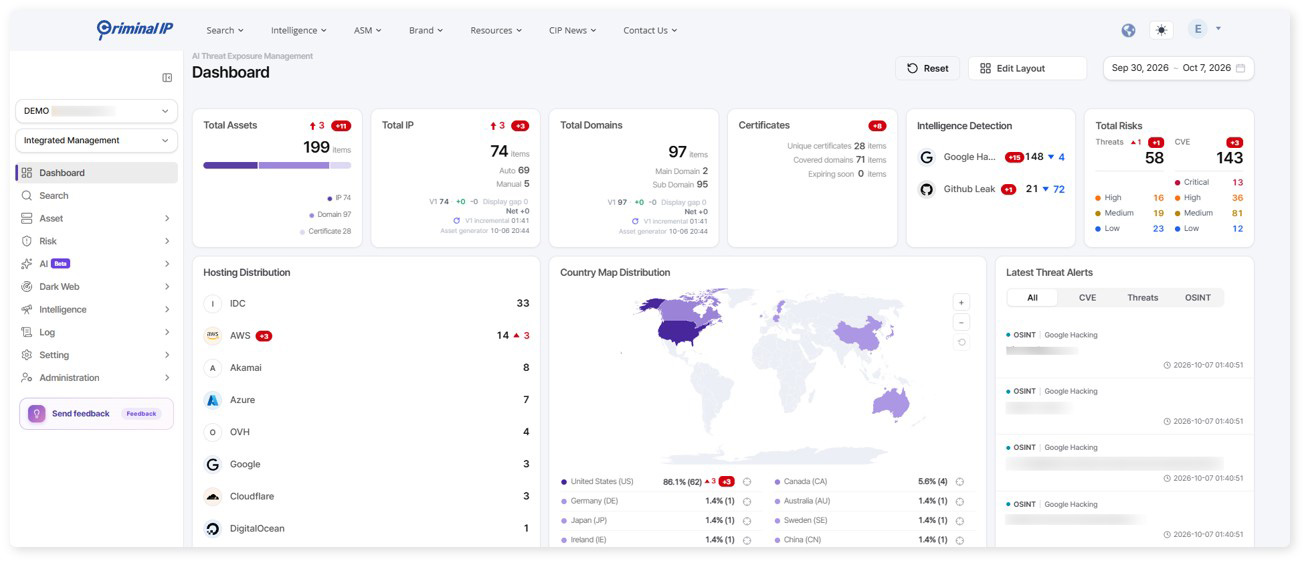
AITEM expands the scope of traditional attack surface management beyond external inventory. Based on Criminal IP’s threat intelligence, it brings the compromise of external assets, open source information, dark web data, internal infrastructure, shadow AI, leaked data and emerging vulnerabilities into a more comprehensive approach to managing the threat landscape.
Rather than being limited to detection and generic risk assessments, AITEM is designed to connect fragmented insights with the context security teams need to investigate, prioritize and respond.
Discover how AITEM combines criminal IP threat intelligence with AI to connect threat detection, investigation, prioritization and response.
Discover a more comprehensive view of risks related to external assets, internal infrastructure, OSINT, dark web data and shadow AI.
AI-supported across the entire exposure lifecycle
AITEM applies AI in four phases of exposure management:
- Recognize – Connect emerging threats and vulnerabilities to the products, services, and assets that actually exist in an organization’s environment.
- Investigate – Enable security teams to examine assets, exposures, vulnerabilities, and security findings using natural language while bringing relevant context together in one place.
- Prioritize – Assess exposure against enterprise-defined risk criteria along with real-world exploitability and attacker activity, rather than relying solely on generic risk assessments from vendors.
- Automate – Turn prioritized findings into alerts, tickets, and workflow actions that can be routed to the appropriate teams to move critical threats from detection to response.
Threat intelligence at its core
AITEM is powered by criminal IP threat intelligence and adds real-world context to threat management beyond pure vulnerability data.
Open ports, exposed services, vulnerabilities, connected infrastructure, abuse history, scanner activity, threat mapping, and malicious infrastructure can be brought together to help security teams understand not only what is being disclosed, but also what is happening around that disclosure and why it matters.
AITEM represents Criminal IP’s approach to advancing attack surface management: expanding visibility beyond the external asset inventory and linking threat detection to investigation, threat context, prioritization and response.
From Visibility to Threat Hunting at GovWare 2026
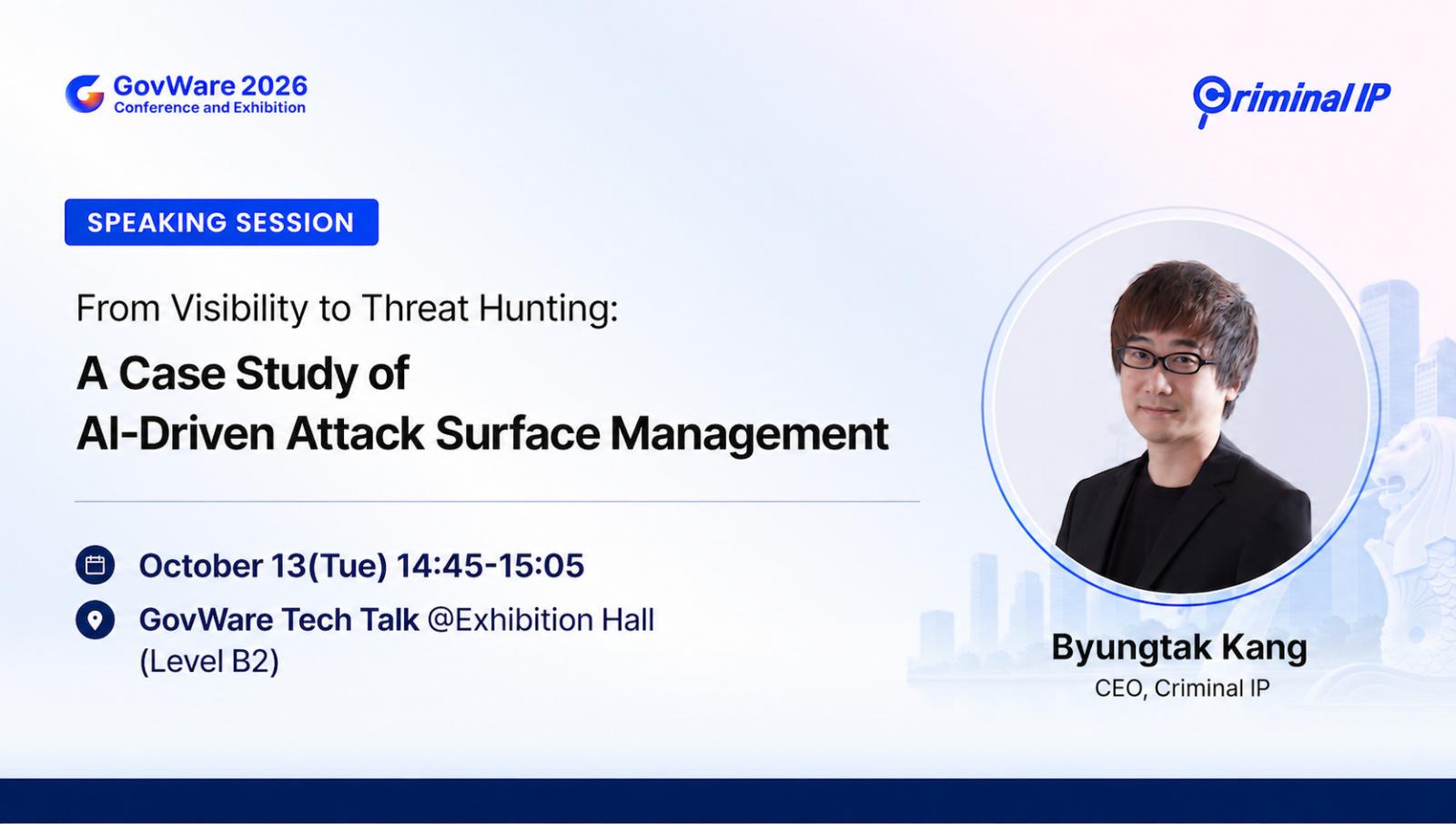
At GovWare 2026, Byungtak Kang, CEO of AI SPERA, will speak “From Visibility to Threat Hunting: A Case Study of AI-Driven Attack Surface Management” as part of the conference program.
Using real-world examples, the session explores how threat intelligence and attack surface visibility can support faster investigation and more effective security response. The change from the discovery of the threat to the understanding and appropriate reaction is also examined.
The comprehensive industry change
The direction Criminal IP is taking with AITEM reflects a broader shift in the global security industry. At RSAC 2026, agent AI, AI SOC and shadow AI were the key topics as leading security vendors continued to move from siled security tools to more integrated, AI-driven security operations.
“The ASM competition is no longer about who finds the most assets,” Kang said. “It will be about who can move faster, respond more effectively and mobilize the organization. AI should do the repetitive analytical work. Humans should focus on judgment, accountability and prioritization.”
About AI SPERA criminal intellectual property
Criminal IP is a cyber threat intelligence solution powered by AI SPERA that provides actionable threat intelligence and attack surface management solutions to security teams worldwide.
By continuously scanning the global Internet, Criminal IP aggregates and contextualizes threat signals across IPs, domains, URLs and attack infrastructure, covering malicious indicators, known vulnerabilities, exposed assets and attacker behavior.
Criminal IP’s mission is to give organizations true insight into their cyber landscape and accelerate threat detection and response by providing the information needed to outwit attackers.
For more information, see www.criminalip.io
Sponsored and written by Criminal intellectual property.