
Brady Snyder / Android Authority
Add Android Authority to Google:
I’ve been walking the line between Google Health and Apple Health since I bought my first wearable. I ran with the Fitbit Charge HR for a few weeks before switching back to the Apple Watch Sport in 2015, and I’ve been wearing the Apple Watch for a decade. A lot has changed since Google bought Fitbit and has since overhauled the platform, culminating in the latest Google Health rebrand.
I’ve been playing around with the new Apple Health app in the iOS 27.2 developer beta, and I’m pretty sure that’s what Google Health should be like in the first place. I also have a guess as to why Apple’s and Google’s health apps are so different, and the underlying problem isn’t easy to solve.
Which health platform do you think is the most promising?
7 votes
Apple’s health detection system puts raw data first

Brady Snyder / Android Authority
The redesigned Apple Health app requires new hardware, and this is the worst of it. If you have an iPhone capable of running Apple Intelligence — it’s an iPhone 15 Pro, iPhone 15 Pro Max, or newer — you’ll be able to use the new Apple Health app when it becomes available to the general public later this year. People with older iPhones are unfortunately stuck with the existing Apple Health app and can’t update it. It’s much more limited than the new Google Health app, which at least works with devices running Android 11 or iOS 16.4.
I installed iOS 27.2 developer beta on my iPhone Air and put my Apple Watch Ultra 3 on to try out the new app, and a few things worked right away. The Apple Health app now opens to the Insights tab, which finally includes the Activity Ring data front and center. Before, you had to fight between the fitness and health apps to see all the Apple Watch metrics. Another highlight is the Apple Watch’s Longevity tab, which calculates your health age using basic fitness data.
It’s clear that Apple is trying to join this exclusive tier of health-conscious wearable brands.
Best of all, you can take personalized tests using your Apple Watch and iPhone camera to get a more accurate estimate of your health age. They use vision-based AI models to analyze health in real-world tests, and since they can be retaken at any time, they can be used to track their progress. One such assessment is the VO2 max test, which measures the maximum amount of oxygen your body can take in during extreme exercise. This is the first manual VO2 max test for Apple Health and there is no Google Health equivalent.
I was able to instantly see my health age in the Apple Health app, but I need to feed it more fitness, sleep, and test data before I can get an accurate reading. This is a feature that Google Health doesn’t have. It’s a popular health indicator backed by brands like Garmin, WHOOP, and Oura. It’s clear that Apple is trying to join this exclusive tier of health-conscious wearable brands.

Kaitlyn Cimino / Android Authority
I couldn’t use Apple Health’s other new “Prep” feature. Apple is behind the curve because it’s only now adding readiness score to the Apple Watch. Google Health has a score on a scale of 1 to 100 that assesses your body’s readiness for the day and for planned exercise.
Apple’s score is slightly different because your Readiness is on a scale of zero to 10 and comes with one of four simple suggestions: “Recover,” “Pace Yourself,” “Ready” or “Go For It.” I like the simplified approach of Apple Watch’s new readiness indicator, but my Apple Watch isn’t compatible with it.
It’s horrible. I paid $800 for an Apple Watch Ultra 3 a year ago and now it doesn’t get the latest Apple Health features. You need the latest Apple Watch Series 12 or Ultra 4 to get it, and this limitation sets a dangerous precedent. Should I expect to pay $800 every year for a new Apple smartwatch?
Should I expect to pay $800 every year for a new Apple smartwatch?
At least there is a reason for the restriction. The fitness indicator uses the Health Sensing system, which includes new optical and electrical heart rate sensors and is powered by the updated S11 chip. Heart rate is now measured every five seconds, and heart rate variability is measured 24 times more often than before. My Apple Watch Ultra 3 doesn’t have the hardware to give an accurate readiness reading, at least according to Apple.
What’s clear from the simple version of the new Apple Health app is that Apple is taking a data-driven approach. Apple Intelligence provides concise, clear AI summaries of your metrics in the new app’s Insights tab. However, these conclusions are not suggestive or too definitive. They come with data points, graphs and charts, just like the previous Apple Health app.
Google Health is trying to compensate with a smart AI trainer

Brady Snyder / Android Authority
Look at Google Health’s Today tab next to Apple Health’s Insights tab and you’ll immediately notice the difference between the two apps. Both applications dynamically adjust what is displayed on these pages based on the time of day and the data being recorded. In the morning, Apple Health and Google Health show a summary of your sleep. In the evening, two apps can analyze your activity data for the day or summarize your last workout. The contrast lies in how each application chooses to display this data with AI.
Google uses Google Health Coach, an AI-powered assistant designed to help you improve your fitness and health and organize your day. You can ask him questions about your health or create an exercise plan for you. It identifies key points and potential action items and provides summaries of your data. But they all come with an important disclaimer: “AI responses may contain errors and not medical advice.” This caveat is important because Google Health Coach doesn’t stop talking.
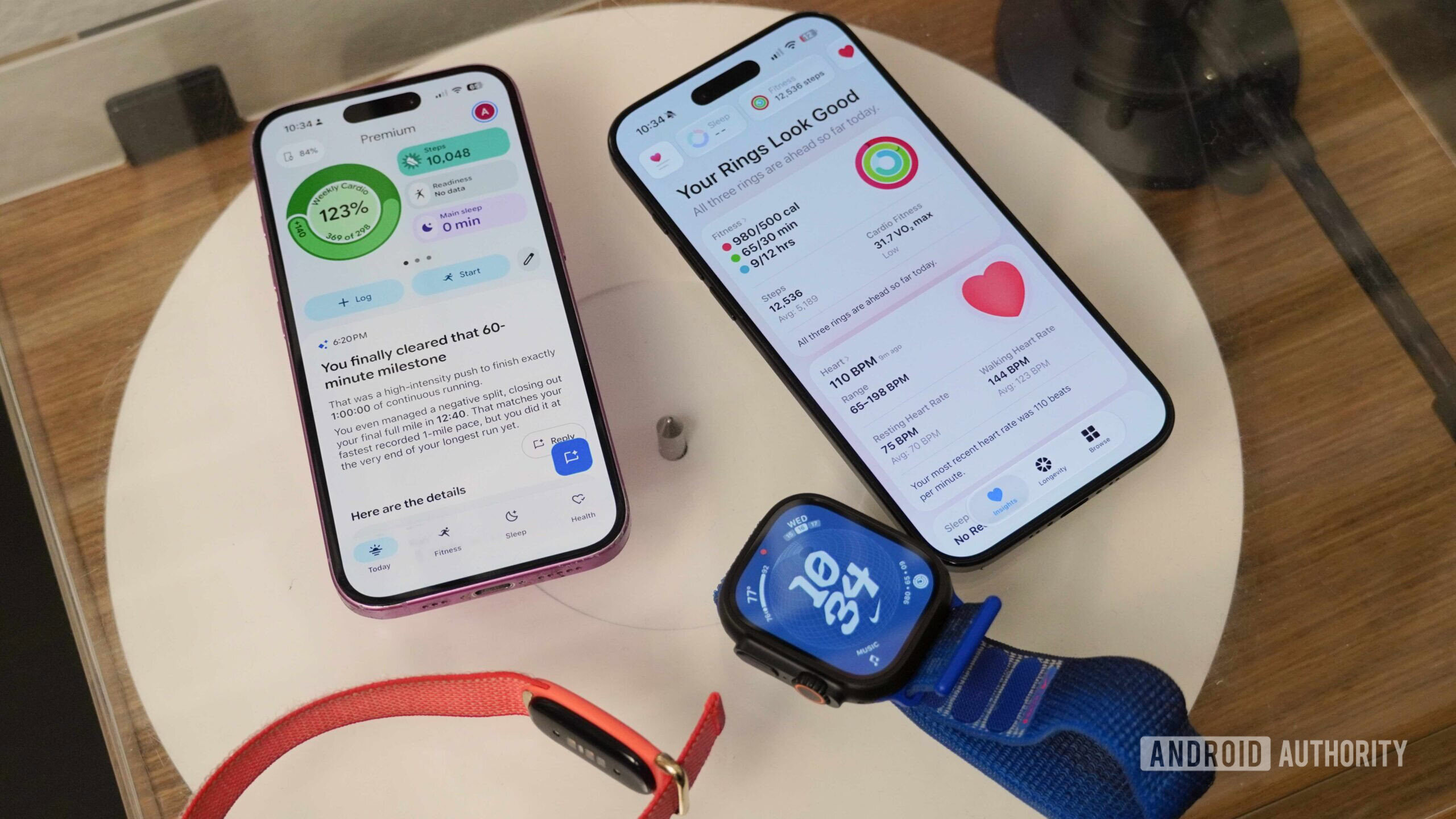
Check out the photo above to see how the Google Health app (left) and the new Apple Health app (right) display health and fitness data after a run. Google Health uses a few sentences to recap your run, but it actually provides two specific data points: run length and last mile split. The new Apple Health app doesn’t go off on tangents about specific exercises or constantly suggest next activities. Instead, it focuses on the bigger picture, like where activity rings and vitas are trending.
It’s worth noting that this is the first developer beta of iOS 27.2, which includes the new Apple Health app. It can and will change before the official release. But based on what I’ve seen so far, between my testing and the Apple show, I’m incredibly optimistic.
I’ve been using Google Health religiously for a few months with my Fitbit Air, and I always get the feeling that the chatty nature of the health coach makes up for the lack of data. He doesn’t get the basics right — such as automatic action tracking — so it should be clearly stated: reminding me to drink water, telling me that the desert is incredibly hot (trust me, I know), or yelling at me for forgetting to wear my tracker to sleep.
Instead, Google should have followed Apple’s approach. It could use AI to make health information easier to understand, but the detailed answers from the health coach are simply confusing.
Apple understands that health is not a guessing game

Brady Snyder / Android Authority
I use a $99 Fitbit Air with Google Health and a $799 Apple Watch Ultra 3 with the new Apple Health app, which is part of the problem, but not as much as you might think. Google needs to optimize Google Health to work with both the cheapest Fitbit trackers and the most expensive Pixel Watch 5. I’m sure using the Pixel Watch 5, which has better sensors and dual-band GPS, will give Google Health Coach more data to work with, but it’s designed to be conversational and durable.
I’d like to commend Google Health for supporting so many devices, but that might be the exact problem. Even though Apple is phasing out millions of old phones and smartwatches, it has decided to only support devices that are truly built to handle the experience it wants to deliver. Google device inclusiveness and Overconfidence in Gemini can harm him because I like the empirical approach of the new Apple Health app.
A few months into my Google Health journey, I doubt the accuracy of the platform. It’s hard not to be when a health coach himself tells me that there may be errors in his insights and analysis. There are some things that AI shouldn’t predict, and your health is one of them. It’s still early days, but Apple seems to understand this.
Thank you for being a part of our community. Please read our Feedback Policy before posting.
Related Posts
 Microsoft’s rollback of Copilot continues with scaling it out of OneDrive’s file manager options.
 This ESP32 CYD project turns your display into a Flock camera scanner
 Hackers are using unpatched Plex servers as crypto-miners, and yours could be at risk.
 The 3-2-1 backup rule has an obvious caveat that ransomware exploits very well.