Add Android Authority to Google:
The Pixel and I get along great, but if there’s one area where I always sigh heavily, it’s charging phones. Yes, you can splash the cash on official accessories like the Pixel Flex 67W charger ($59.99 on Amazon), a powerful USB-C adapter in its own right. But not all accessories in the Google charging ecosystem are so good — I’m pointing fingers at the PixelSnap charger ($39.99 at Amazon).
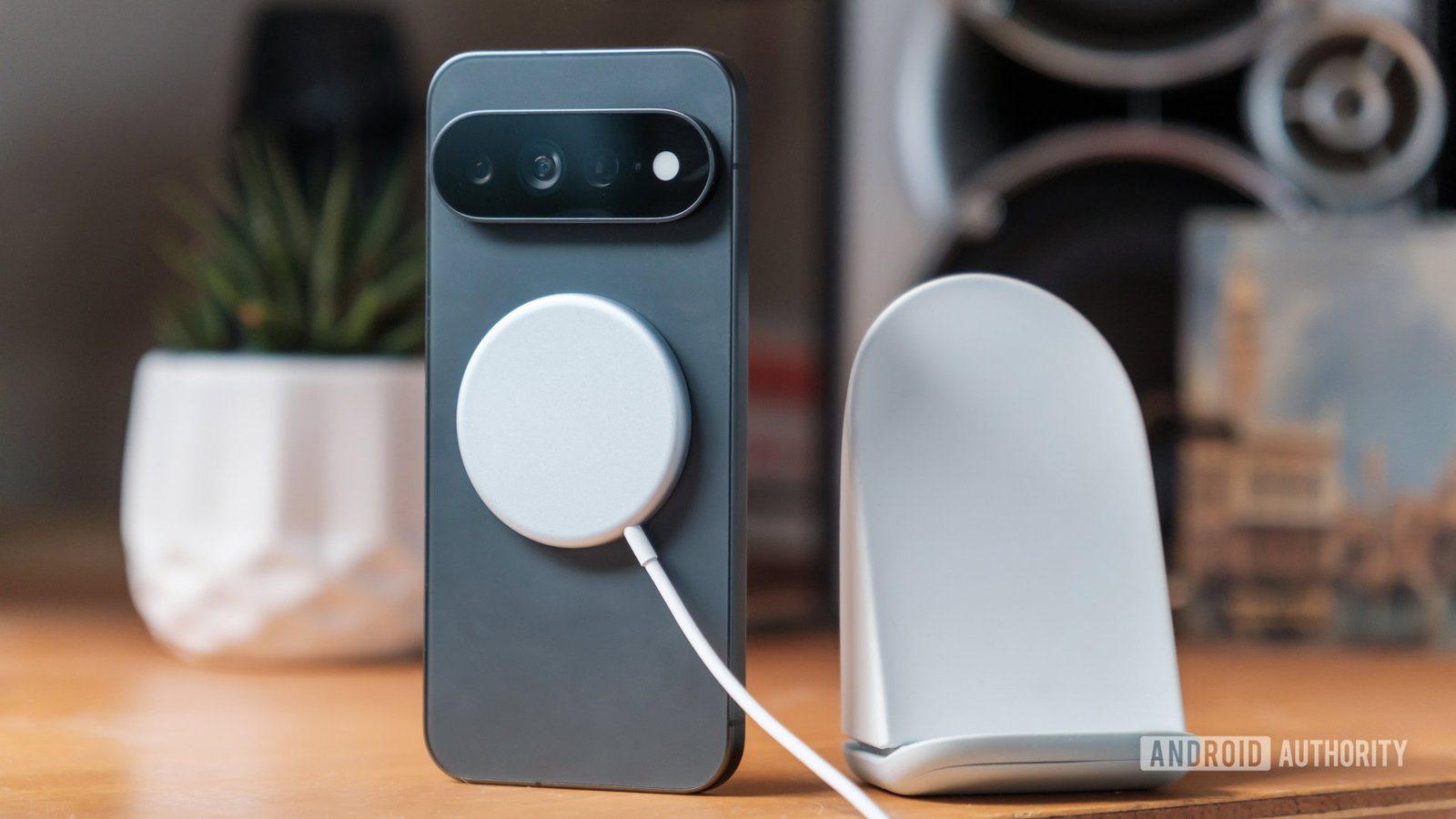
I’m still disappointed that Google ditched my beloved Pixel Stand in favor of the PixelSnap. While the MagSafe case has certain conveniences for accessories, it’s proven to be significantly reduced in terms of charging times, where it really matters. Last year, the Pixel 10 Pro XL using PixelSnap was more than half an hour slower than the Pixel 9 Pro XL on the old Pixel stand.
Google’s 25W wireless charging isn’t like that

For starters, a wireless charger takes an absolute age to get anywhere near 25W (my sample was 23W, which is a lot less than the 31W I used on the 10 Pro XL). He spent a few minutes switching between 9V and 16V for some reason, maybe checking what the phone’s temperature and battery would allow. This is annoying because you would normally expect a charger to start providing maximum power immediately or at least within a few seconds of plugging it in. Instead, it took about six minutes to lock the charger and the phone at maximum charging power, making the time needed for a meaningful charge short.
Unfortunately, he was once again able to maintain peak power for a long time; talk about disappointment. Despite all the talk of 25W capabilities, the PixelSnap is closer to the 15W model.
My Pixel 11 Pro XL draws very little, close to the advertised 25W.
The good news is that peak power levels are slightly better than last year. While the Pixel 10 Pro XL dropped to 10W for the first 30 minutes of a slow charge cycle when I tested it last year, the Pixel 11 Pro XL stayed close to 15W for the best part of an hour. The net result is a faster charging time than last year’s model, taking 119 minutes compared to 145, which is certainly significant. Better power also means the Pixel 11 Pro XL reaches 50% battery in 47 minutes, compared to 61 minutes on the Pixel 10 Pro XL, which is another significant improvement.
But that’s about all the good news in this generation. Temperatures remain high when using wireless charging, making the phone noticeably warmer to the touch. Internal temperatures are limited to 40°C (I didn’t test with extreme charging), which reduces power after the phone’s initial fast charging period. The average temperature of 37.4°C is about half a degree warmer than last year, so this year’s speed increase is not for nothing. However, charging with the PixelSnap is slower and runs hotter than using a regular wired charger.

This is made worse by the fact that Google once had a good wireless charging solution with the Pixel Stand (2nd generation). When using PixelSnap, the Pixel 11 Pro XL still charges much slower than the Pixel 9 Pro XL (2nd generation) on the Pixel stand. The older Pixel 9 Pro XL in both generations can be fully charged in air in 101 minutes and to 50% in just 33 minutes, thanks to its 30W high charging power and a built-in fan that helps keep temperatures down, allowing you to maintain high power for a long time.
Unfortunately, the Pixel Stand is incredibly slow on the Pixel 11 Pro XL. Because the charging coils are no longer aligned or too far apart, power is limited to just 7.5W. This results in an estimated charge time of over four hours, and I didn’t wait to test it. Unfortunately, the Pixel Stand is no longer practical for the Pixel 10 and 11 series, unless you plan to only charge them overnight.
Another disappointing year of Pixel charging

Robert Triggs / Android Authority
Of course, MagSafe is all about maximizing charging power with Qi 2.2, along with convenience. Cases, battery packs, etc. that neatly hug your phone while also providing power or other features. There’s no denying that it’s a tradeoff that many people find profitable. Especially if you have a wired charger to turn your phone back on when you need a quick charge.
The new Pixel 11 Pro XL’s impressive 45W wired charging capabilities aren’t so simple either. Actual peak power output is closer to 41W and only if the charger can provide 18V and 2.27A via USB PD PPS protocol. This reminds me that I need a charger with similar specs for my PixelSnap. Who has time to research all that?
In addition, Google’s new extreme charging mode offers a 5-minute boost at the expense of raising the temperature by about 3 ° C, which in my test reached a very warm 42.9 ° C, which is also not impressive. Needless to say, it’s all a bit of a mess if you want your Pixel to charge as fast as possible without baking itself.
And that’s one of the things the Pixel Stand really achieves—the internal fan helps keep the phone cooler, allowing it to hold more power for longer. What I’d like to see is a new model with built-in magnets to ensure proper alignment and faster, cooler charging than the current bare puck. This provides the best of both worlds. But it’s still a bad joke that Google is still trying to charge $65 for a Snap and Stand combo. Let’s hope for something better next year.
Thank you for being a part of our community. Please read our Feedback Policy before posting.