

A new Counterpoint Research report says Apple’s next-generation MacBook Pro will help drive OLED notebook display shipments up 50% in 2026 alone. Here are the details.
The new MacBook Pro and premium AI computers are expected to demand more fuel
in a report Released today, Counterpoint Research projects that shipments of advanced notebook displays will grow 11% in 2026 compared to 2025, with shipments of OLED notebook displays expected to increase by 50% for the period.
The report notes that the 11% growth in premium notebook display shipments will comfortably outpace the broader notebook display market, which Counterpoint said it expects to decline by 3% annually.
Counterpoint said it also expects OLED to widen its lead over MiniLED in the advanced notebook display market, rising from 56% of shipments in 2025 to 75% in 2026, while MiniLED is expected to decline from 44% to 25%.
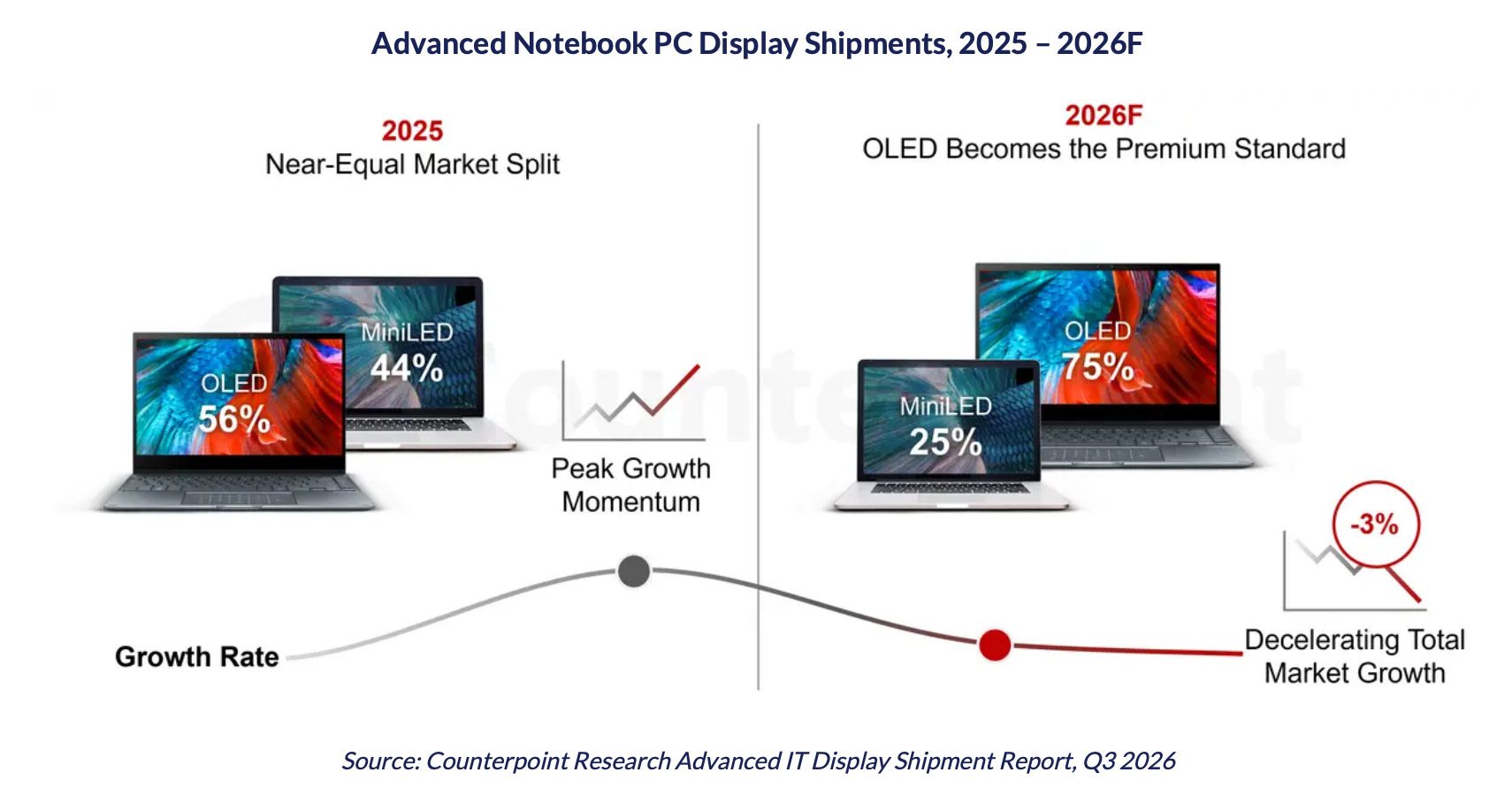
Part of the growth in OLED laptop panel shipments is expected to come from Apple using the technology in its next-generation MacBook Pro, which is currently rumored to be announced on October 27 with a touch screen and a new design, with a much lighter body, the research firm said.
Here is the Counterpoint:
OLED notebook display shipments are expected to increase by 50% in 2026 and another 24% in 2027. Apple’s expected adoption of OLED in the next-generation MacBook Pro, along with continued demand for premium AI computing, is expected to drive this growth.
Contributing factors to the growth of OLED, said Counterpoint, are technology and manufacturing advances such as tandem OLED architecture, which improves brightness, energy efficiency, and panel durability.
Apple already uses OLED tandem in the iPad Pro, where two OLED layers work together to provide a higher full-screen brightness. The company is expected to use a similar two-layer OLED tandem architecture for the upcoming 14-inch and 16-inch MacBook Pro.
Looking ahead, Counterpoint expects OLED notebook panel shipments to grow at a compound annual rate of 26% between 2024 and 2030, while panel revenue is expected to grow at 35% annually over the same period.
You can read the full report on Counterpoint here.